

At what fine particle size does your gold need to be liberated from the rock? The mill isn't selected based on throughput or brand, but rather on the liberation particle size, and also on how much ore becomes slime during the grinding process. This article compares two mills from four aspects: how the ore is crushed, the resulting particle size, where operating costs are incurred, and their respective positions in the process flow.
I. Same Cylinder, Different Contact Methods
Both ball mills are horizontal cylindrical mills, supported by a hollow shaft for rotation, lined with grinding media. The difference lies in how the media contacts the ore:
•Ball mills use point contact. The steel balls, typically 25–125 mm in diameter, fall and cascade inside the cylinder. Each ball impacts a small area of the ore, resulting in high and concentrated stress, a type of impact crushing, very effective at inducing cracks in hard rock.
•Rod mills use line contact. The steel rods, 50–100 mm in diameter, are slightly shorter than the cylinder and arranged parallel to each other along the axis. As the cylinder rotates, the rods roll against each other, crushing coarse particles between them, while fine particles escape through the gaps. The stress is lower and more evenly distributed.
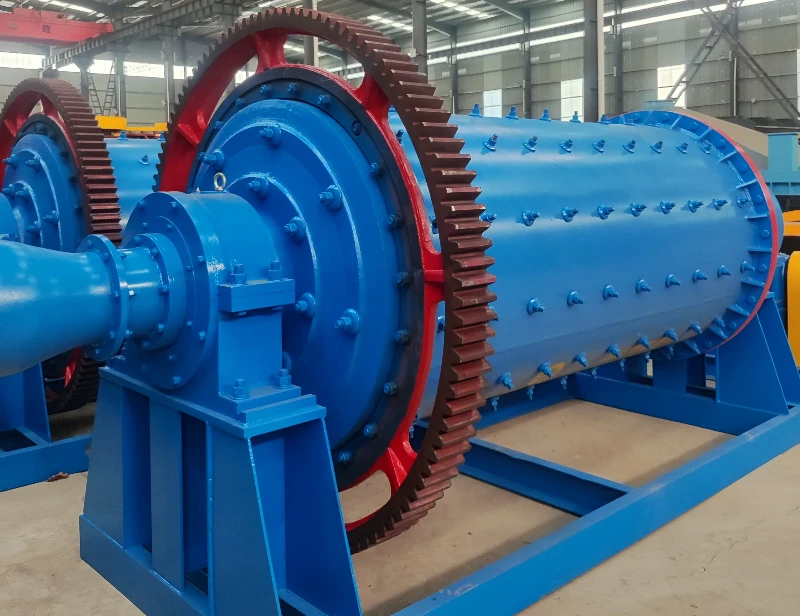
II. Discharge Particle Size: The Real Deciding Factor in Selection
•A rod mill is like a moving bar screen. Coarse particles are trapped between the steel bars and crushed first; fine particles pass through the gaps and are discharged directly. Therefore, the product particle size distribution is narrow, with very little fine powder below 75 µm.
•A ball mill grinds everything inside the mill, including already fine particles. This isn't a drawback; it's necessary when the target particle size is below 75 µm. However, if the target particle size is 1–3 mm, and the next stage involves gravity separation or cyanidation, this becomes a problem: the resulting slime carries away gold, slowing recovery and filtration.
A key principle in mineral processing design is to remember: the product particle size profile of an open-circuit rod mill is almost identical to that of a closed-circuit ball mill (with a classifier). Therefore, rod mills are often placed before ball mills: the first stage of grinding is thorough, and the ball mill only needs to finish the process.
III. Energy Consumption
For gold ore beneficiation plants, especially quartz vein type, pyrite type, and sulfide-bearing gold deposits, the choice between ball mills and rod mills needs to be determined in conjunction with the entire beneficiation process.
Normally, in the first stage of grinding from 20–6 mm to 3–1 mm, rod mills typically process more tons per kilowatt-hour than ball mills. When grinding below 100 µm, ball mills (especially when in closed-loop operation with hydrocyclones) are difficult to replace.
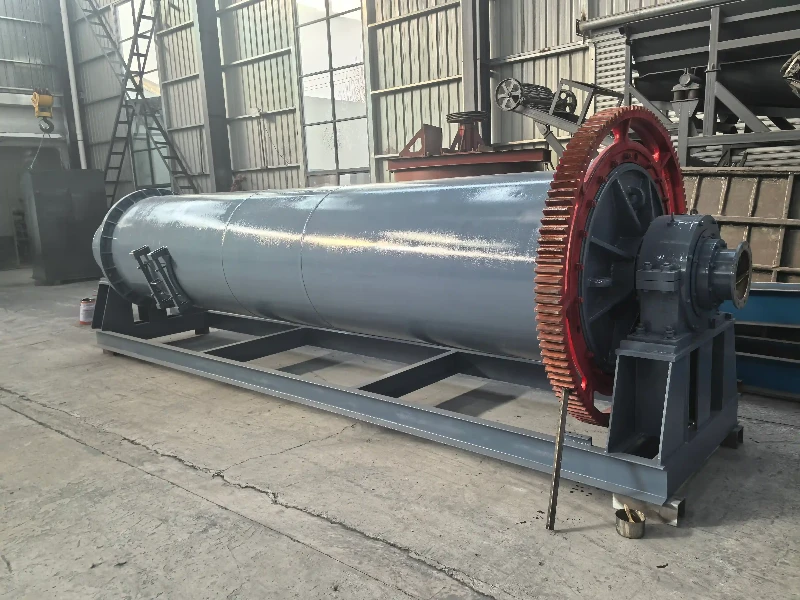
IV. Steel, Liners, and Wear Parts
Steel consumption is a monthly expense incurred after selecting the wrong mill model.
Steel Bars: High-carbon steel, 0.8–1.0% carbon content, 50–100 mm in diameter, 25–50 mm shorter than the mill body. The bars and ends wear down, becoming thinner and prone to bending and tangling, so regular replacement and trimming are necessary. We recommend customers keep 10–15% spare steel bars on site.
Steel Balls: 25–150 mm in diameter, proportioned according to feed and product particle size. Steel ball consumption increases rapidly with the abrasiveness of the ore; therefore, in gold mines with high quartz content, the cost per ton of steel balls is significantly higher than in limestone mines.
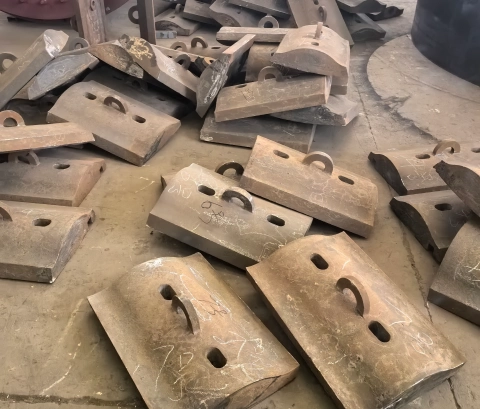
Lensers: Rod mill mill bodies use smooth, low-ripple liners because the media is in a cascading state; ball mills (especially the first stage) require lifting bars to carry the heavier, cascading media upwards.
Rubber liners are suitable for wet fine grinding but not for high-impact conditions. Large-diameter media and sharp, coarse particles can cut and tear rubber; rubber properties also deteriorate with increasing temperature, so dry grinding or high-temperature grinding is not suitable. High-manganese steel will work harden under repeated impacts, but it remains the default choice for the first stage of coarse grinding. The material selection is determined by four variables: maximum media diameter, slurry temperature, critical velocity percentage, and feed particle size, not by the price per kilogram of liner.

V. Placement of the Two Types of Mills in a Gold Ore Process
Rod mills are placed in the first stage, suitable for:
Gravity separation (shaking tables, centrifugal concentrators) before cyanidation, as slime can affect gravity separation. This is why rod mills have been used in tungsten-tin ore and other rare metal gravity separation plants for decades.For brittle or heavily weathered ores, with a feed size of approximately 20 mm and a target product size of 1–3 mm, open-circuit processing is sufficient; no classification equipment needs to be purchased or operated.Afterwards, there is a ball mill; the rod mill only needs to deliver a clean 1–3 mm feed.
Ball mills are placed in the first stage, suitable for:
Liberation particle size requiring 75–150 µm, with processes involving cyanidation, flotation, or CIP/CIL.For ores of hard quartz or magnetite, impact rather than grinding is required. Long steel bars are prone to bending and wear in hard, coarse feeds, increasing steel consumption.
Frequently Asked Questions
1.Can a rod mill replace a ball mill in a CIP gold mine?
Only if the gold has already been liberated, or the liberated particle size is greater than 1 mm, which is rare. Most CIP plants need to grind to below 150 µm, which is economically unfeasible with a rod mill alone.
2.Is a rod mill always cheaper to operate?
Not necessarily. For 1–3 mm products, it has lower power consumption and simpler liners; however, the steel rods need to be periodically removed and replenished, the cylinder is longer, and the foundation and plant costs are higher. The two mills should be compared under the same feed and product particle size.
3.Why do steel rods get tangled?
There are three common reasons: insufficient media, failure to promptly remove worn or bent steel rods, and rotational speed exceeding the discharge range. The solution is to stop the machine, pull out the tangled steel rods, restore the filling rate to 35–45%, and check the rotational speed against the mill's critical speed.
4.Can a rod mill dry grind?
Yes, but using rubber liners is not recommended because dry grinding lacks water to dissipate heat; moreover, rod mills are mostly used for wet grinding. Please inform us of the feed moisture content before finalizing the dry grinding plan.